Showing posts with label Oil on Canvas. Show all posts

Thursday, November 21, 2019

That's Doctor Bad-Ass to You

We are aware of countless stories about women who take care of the home and family while their husbands pursue successful careers. Sometimes these women even manage a portion or all of the 'back office' activities so that the husband can concentrate on the product or growing the business. It's been interesting to learn that in the 16th century we have several examples of men that helped run the household and manage the business side of the studio so that their talented wives could be free to paint. A recent post discussed Diana Scultori and how she and her husband worked together and ran a successful business. We also have learned that Sofonisba Angussola's husband supported her career for many years.

This trend continues with our next artist - Renaissance painter Lavinia Fontana. Lavinia was a portrait artist. Not unusual, because by this time portraits were typical for women painters.  However, Lavinia also received commissions for religious and mythological works, which sometimes included female nudes. 
Related image
Self Portrait, Lavinia Fontana

Lavinia was born in 1552 in Bologna. She was trained by her father Prospero Fontana and was active in Bologna and Rome. She is regarded one of the few, and maybe the first female career artist in Western Europe.  She relied on commissions for her income; an income which was used to support her family. Her husband -  Gian Paolo Zappi - was a fellow artist and student of her father. As Lavinia's success grew Gian assisted with her work,  served as her agent and raised their eleven children.  

Yes, eleven children. That didn't slow Lavinia down a bit. In addition to everything else, she got her doctorate from the University of Bologna, and she also became a member of the Academy of Rome. 

Both financially and critically successful, Lavinia's paintings were characterized by their poised compositions, attention to detail and the use of a delicate palette.  In her self portrait (above) you can see the careful attention the the placement of the figure, the detail of the clothing and the choice of color. Here she is impeccably dressed in lace and jewels. She paints herself as a scholar, studying items from an archaeological find. 
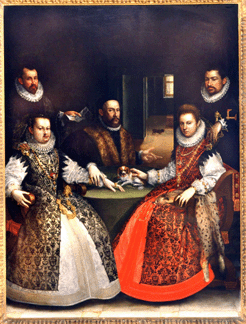

Image result for portrait of the gozzadini family
Portrait of the Gozzadini Family,
 Lavinia Fontana
Lavinia was skilled not only at painting realistic images but also capturing the subject(s) mood. Her "Portrait of the Gozzadini Family" (left), is a psychologically complex image. it is said that this painting was commissioned by the father of the two women in the painting as a reminder that that the money they brought with them into their marriages is ultimately of their own inheritance, and not to be withheld from them by their husbands. 


Antonietta Gonzalez, Lavinia Fontana
Another unusual work is the somewhat unsettling painting of Antonietta Gonzalez. Little Antonietta  (as well as her father, two sisters and other family members) had hypertrichosis (also commonly called "werewolf syndrome"). This is a rare genetic disorder which causes an abnormal amount of hair on the body. While this could have resulted in the family being outcast, in fact they were welcomed in to the courts of Europe. Lavinia painted Antonietta in 1595 and you can almost feel the compassion for the child flowing from the paint brush. Her eyes are inquisitive and her faint smile sweet and trusting.

Lavinia had the largest body of work for a female artist up to this time - 135 paintings have been attributed to her. Her Patrons were Pope Gregory XIII, Pope Clement VII, Pope Paul V. She was the recipient of a rare honor in 1603 when Pope Clement IX summoned her to an audience in the papal palace. Clement commissioned an altarpiece for the church of San Paolo Fuori le Mura. The resulting was a 20 - foot altarpiece titled "The Stoning of St. Stephen Martyr"  and became the best known of her work. Unfortunately, the church burned in 1823 and the painting was lost.

Lavinia Fontana was a wildly talented artist. She was a creative, intellectual woman who was an inspiration for artists such as Artemisia Gentileschi and Elisabetta Sirani (who we will learn more about in the upcoming weeks). But most importantly, she was a bad-ass that portrayed herself as a painter, a musician and a scholar.


++++++++++++++++++++++++

Selected Sources

Great Women Artists. Phaidon Editors


Lavinia Fontana Facts. https://biography.yourdictionary.com/lavinia-fontana

McIver, Katherine A. “Lavinia Fontana's ‘Self-Portrait Making Music.’” Woman's Art Journal, vol. 19, no. 1, 1998, pp. 3–8. JSTOR, www.jstor.org/stable/1358647.


Thursday, September 26, 2019

Thinking Big

Related image
Plautilla Nelli, Pained Madonna

Florence, early 16th century. This is the center of the art world. While several important renaissance artists were working in Rome, buy the beginning of the 16th century Florence had risen to become the capital of the art world. Artists like Cimabue and Giotto had began to break away from the Byzantine style of art which was somewhat flat and stylized to producing works where the subjects were much more life like. Their work began the transition to what we think of today as Italian Renaissance art. Many artists followed them, creating not just beautiful work, but a wealth of information about portraying the human form, linear perspective, and understanding the play of light across a subject.

This is the world that our subject for today's blog is born into. Plautilla Nelli was born to a wealthy fabric merchant in 1524. Both she and her sister, Costanza, also became a nun. Nelli became a painter and Costanza became a writer.

Nelli is reported to have been self taught. Fortunately her convent of Santa Caterina da Siena was not fully cloistered, so Nelli could have had access to live models. She ran a working studio in the convent that where other artists would regularly visit. She inherited the drawings of Fra Bartolomeo, a prominent painter of the time. Artists such as Perugino, Andrea del Sarto and Giovanni Antonio Sogliano may have influenced Nelli.

Her studio was likely a gathering place for her patrons. She was apparently well known and her paintings were in demand. In his Lives of Artists, Giorgio Vasari wrote that Nelli “had so many works in the houses of gentlemen that it would be tedious to speak of them all.”

In my mind there are three things that elevate Nelli to Bad Ass Status; the courage to show her subjects feelings, the definite feminine point of view, and the size of some of her work.

Plautilla Nelli Last Super

Subjects in Nelli's paintings appear to be very much present in the moment. Look at her Last Supper.  In the center Jesus lovingly comforts an apostle. The third apostle to the right appears concerned, thoughtful. Three apostles on the left are in deep, somewhat agitated conversation. You can almost hear what they are saying.


Image may contain: 7 people, people sitting
Plautilla Nelli, Lamentation
In her Lamentation you can almost feel the despair of the mourners. The women's noses are red from weeping; their posture betrays their anguish. These are women who are heart broken. In the background we see three men, one caught up in the sadness of the situation, the other two, more stoic and removed from the scene. In this painting Nelli portrays the pain and suffering of women in a way that it had not been seen before. You can see that suffering in the face of the Pained Madonna (above).

I believe Nelli also used size as a way to convey the messages behind her paintings. The Lamintation is nine and a half feet tall and six feet ten inches wide. During Nellis time it was displayed in the convent in such a way that the viewer would have been on eye level with the weeping mourners. This would have been a powerful way to draw the viewer into the scene.

Nelli's Last Supper is so large that the viewer could feel as though they are sitting at the table. At 23 x 6.5 feet it is the largest painted work by an early female artist. I think about what it would have taken to produce such a work. The largest painting I've ever undertaken was four feet by five feet and it was exhausting!! I can imagine Nelli day after day working on the images; climbing a ladder to add the tiny detail on the serving bowls or sitting on a scaffold to add the decorative trim on Jesus collar.

We may never know Nelli's thought process or why she made the choices she did but, thankfully, we have many of her works to admire and be inspired by.

+++++
Additional Information on the Last Supper. This magnificent painting was rolled up and in storage from 1808 until 1853. During this time it sustained significant damage.  The restoration was developed by The Advancing Women Artists Foundation and The Florence Committee of the National Museum of Women in the Arts and is expected to be completed in October of 2019.

+++++
Selected References

Advancing Women Artists Foundation  http://advancingwomenartists.org/artists/plautilla-nelli

Plautilla Nelli – the Nun who started a Women’s Art Movement in Florence in the 1500’s – now stronger than ever. https://www.beyondtheyalladog.com/2017/03/plautilla-nelli-the-nun-who-started-a-womens-art-movement-in-florence-in-the-1500s-now-stronger-than-ever/

Garrard, Mary D. Repositioning Plautilla Nelli’s Lamentation. Essay. In Conversations: An Online Journal of the Center for the Study of Material and Visual Cultures of Religion (2014). doi:10.22332/con.ess.2014.1

Michalska, Magda . Restoration of “Last Supper” You Had No Idea Existed. https://www.dailyartmagazine.com/restoration-of-last-supper-by-plautilla-nelli/

+++++

On a side note - if you aren't familiar with the Web Gallery of Art I'd encourage you to visit. It's a great resource that allows you to enlarge the paintings so that you can view detail.