Thursday, January 16, 2020

Painter of Heroines

Judit decapitando a Holofernes, por Artemisia Gentileschi.jpg
Artemisia Gentileschi. Judith Slaying Holofernes

Last summer when I began writing about Women Artists I knew this day would come. The day I would have to write about Artemisia Gentileschi. Artemisia as a subject is terrifying - mostly because I admire her and feel small in comparison to the task of sharing her story. Many authors have written about her, so, what could I add to that story?

With your indulgence I hope to explain over the next few blog posts why I'm certain that Artemisia Gentileschi is the quintessential Bad-Ass.

It would be very easy to start with "Artemisia Gentileschi was born in Rome on July 8, 1593". But, instead, let's start with the paintings - specifically the subjects of the paintings. Later, when I share more about her life and art, the particular way she tells the stories of the subjects will begin to make sense.
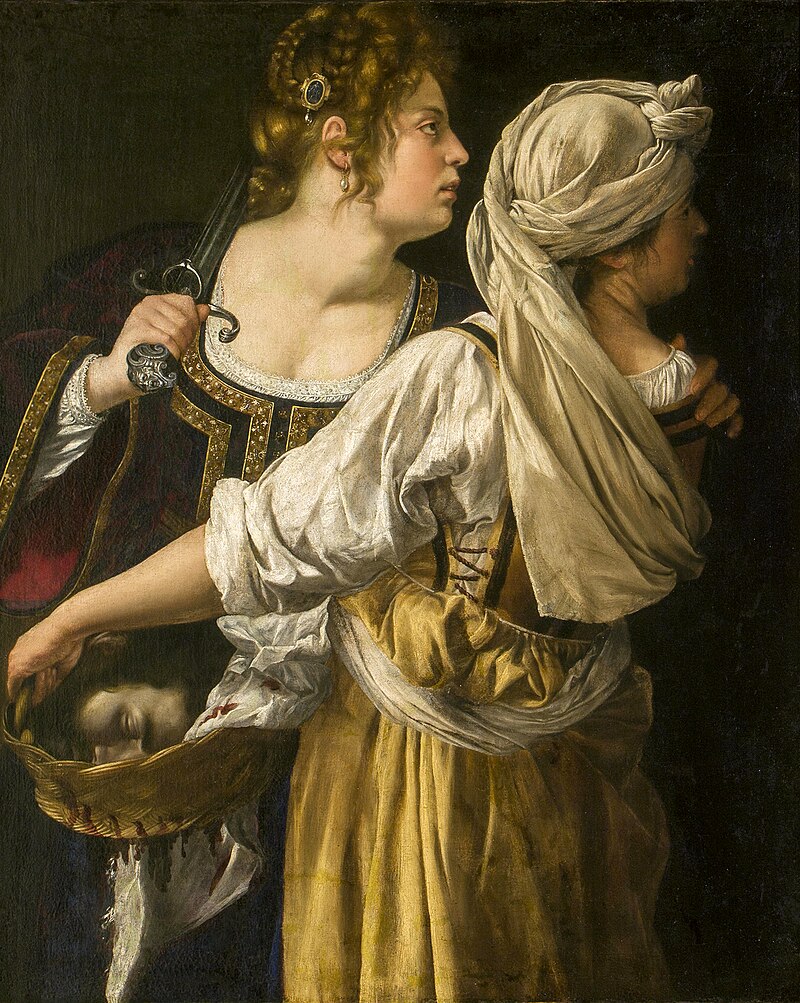
Gentileschi judith1.jpgNo Renaissance artist portrayed women in the same way Artemisia Gentileschi did. Artemisia made the women in her paintings whole, passionate, vibrant, and powerful. In Judith Slaying Holofernes* Artemisia portrays the women as the heroes of the moment. Rather than painting Judith as a courageous beauty she is portrayed in the act of beheading Holofernes. Judith's maid assists by holding the struggling man down while she labors with the sword against his throat. Blood dramatically sprays across the maids arm, but neither women flinch. They are terrible and beautiful carrying out their mission.

Artemisia painted this subject several times and from different points of view. One version captures the moments immediately after the beheading as Judith and her maid collect Holofernes head in a basket. They pause, looking up from their grisly task as though they have been startled. Another version shows Judith and the Maidservant immediately after their work is done, peering back over their shoulders as though they are checking to see if they are being followed. In this painting we see Judith, triumphant, sword resting on her shoulder. Her face calm and resolute. Almost as an afterthought the head of Holofernes rests in the maids basket.
Susanna and the Elders (1610), Artemisia Gentileschi.jpg
Artemisia Gentileschi, Suzanna and the Elders

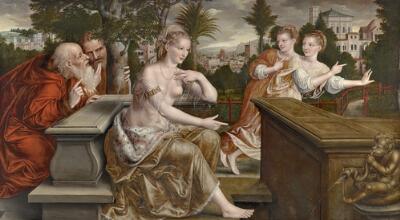
In Artemisia's Suzanna and the Elders Suzanna is not some flirtatious girl who coyly ignores the attention from the old men, as in Massys piece (below). No, Artemisia painted Suzanna twisting away from the two lecherous old men watching her, horrified at being spied on.
Susanna and the Elders
Jan Massys, Suzanne and the Elders


Artemisia paints these women as heroines. Women that are morally strong, brave and courageous. Women who are protagonists. Just like Artemisia.


*As the ancient story relates, Assyrian king Nebuchadnezzar sent his general Holofernes to besiege the Jewish city of Bethulia. Judith, described as a beautiful young widow, resolves to save her people by slaying Holofernes herself. After reciting a long prayer to God, she dons her finest clothes in order to seduce him. After Holofernes has drank enough wine to become intoxicated, Judith decapitates him with his own sword, winning a decisive victory for the Israelites. (Angelica Frey, ARTSY, April 04, 2019)

+++++++++++++++++++
Selected Sources

The Art Story: Artemisia Gentileschi Artworks. https://www.theartstory.org/artist/gentileschi-artemisia/artworks/
Frey, Angelica. How Judith Beheading Holofernes Became Art History’s Favorite Icon of Female Rage. https://www.artsy.net/article/artsy-editorial-judith-beheading-holofernes-art-historys-favorite-icon-female-rage
Vickery, Amanda. Bring female artists out of storage. https://www.theguardian.com/artanddesign/2014/may/16/bring-women-artists-out-of-storage

Friday, January 10, 2020

A Feast for the Eyes


They say that we eat with our eyes first. I think Clara Peeters must have known that. While Fede Galizia ( the amazing Italian artist that I wrote about a few weeks ago) blazed a trail for still life painters Clara Peeters refined the genre and set the Dutch art scene on fire with her work. Her realistic paintings are lush and inspiring - that is the reason I choose her work as the background for this blog.

Image result for clara peeters"
Still Life with Flowers and a Golden Cup, Clara Peeters
There are few facts available about Clara's private life. Most scholars believe she was born around 1585, give or take 5 years. There are baptism and marriage records from Antwerp for a Clara Peeters, however the name Clara was fairly common and Peeters was extremely common, so we can't be sure this is Clara Peeters the Artist. Her brush work suggests that she was trained in Antwerp and one of her later works bears the stamp of the Antwerp guild, so certainly she lived there for a time.

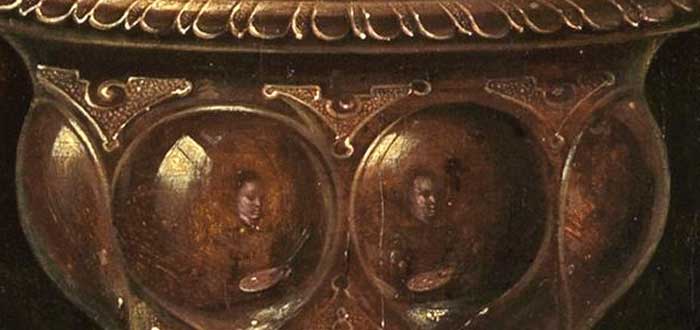
It is apparent that Clara was intrigued by reflective surfaces. Most every painting is a beautiful balance between shadow and light that is punctuated with reflections. We see a loaf of bread reflected on a silver plate, red wine reflected through a clear goblet, onto a silver tray below. And most interestingly the tiny self portraits - painted as reflections on gold or silver vessels.


Clara Peeters |  7 curiosities of a woman painter who changed history
Detail, Still Life with Flowers and a Golden Cup, Clara Peeters
Clara popularized "banquet" (or breakfast) still lifes. These were lavish displays of fruits, cheeses, meats, metal and ceramic dishes, tableware,  and flowers. As a woman artist in the early 17th century Clara would not have had access to nude models, so she painted what was everyday and familiar to her. We can learn as much about the diet of a Netherlandish family from her paintings as we can about making beautiful art. With her brush she celebrates an abundance of fish, fowl and bakery items in vivid, mouth-watering detail.


Image result for clara peeters"
Vanitas Portrait of a Woman, Clara Peeters
Another interesting reflection appears in a "vanitas" painting that Clara produced in 1610. Vanitas is a specific type of still-life that emerged in the 17th century in the Netherlands. The carefully composed objects were meant to remind the viewer of the transience of life. These symbols often contrasted life and death, wealth and poverty, health and illness, etc. Clara's painting, Vanitas Portrait of a Woman, is a remarkable example of a vanitas work. In it we see a young woman (maybe a self-portrait), seemingly in the prime of life. But she looks sad and maybe a little bored with the riches spilled across the table before her. Clara uses flowers in the background to symbolize life, but if you notice there is one flower drooping and wilting, reminding us that life is short and death near. A small-ish bubble floating near the center of the painting. The bubble was a fairly common symbol used in vanitas painting, on par with candles, an hourglass or flowers. The bubble is used to symbolize the fragility of life.

Unlike other artists of the time, there are no records that Clara had any noble or wealthy patrons. However, she must have been successful. At least two of her paintings appear on the inventories of the Spanish King as early as 1627. It appears that Clara ceased painting around 1621. Some speculate that she married, and subsequently stopped painting, or that she may have passed away around this time.

++++++++++++++++++++

Selected Sources

Decoteau, Pamela Hibbs. Clara Peeters 1594-ca. 1640 : and the Development of Still-life Painting in Northern Europe
Vaninskaya, Anna. Fantasies of Time and Death. Palgrave Macmillan, London


Tuesday, December 24, 2019

A Wife, a Mistress. and a Queen Walk into a Château...

This is a story of three women and a castel. More specifically, a château. A beautiful château that sits astride the Cher river in the Loire Valley near the small village of Chenonceau.

The first structures that stood on the property were a mill house and a small medieval castle from the 11th century. In 1513, Thomas Bohier, chamberlain of the king of France, determined to acquire the property, raze the existing buildings, and in their place create a Renaissance château.

Yule decoration at Château de Chenonceau 
Here is when we get introduced to the first woman in the château's history - Katherine Briçonnet. Katherine was Thomas's wife, and as it turns out, the designer of the château. Thomas was called away to war, so Thomas had to spend time away from the property;  Katherine assumed control of the project.

One of Katherines most significant contributions to Château de Chenonceau was the building of a staircase which proceeds straight upwards. Most staircases of this time were spiral or curved and apparently Katherine was looking to create something more practical.

 Sadly, Thomas and Katherine didn't get to spend much time enjoying the château. Both had passed away by 1526 and their son Thomas inherited the château. King Francois I became the owner of the château when Thomas had to give it away because of his debts.

Château de Chenonceau in Winter

On the death of King Francois I, his son and heir, Henry II became the owner. Henry decided to give the castle as a gift  to his mistress, the noblewoman Diane de Poitiers. Diane was delighted with the château and decided to add to it.

Diane contributed what is foundation for most iconic part of the château --  the magnificent arched bridge across the river. She also had the formal garden added to the property. Diane's time at the Château de Chenonceau came to an end with the death of Henry. Henry II’s widow Catherine de Medici, the Queen of France, had taken a fancy to Château de Chenonceau and wanted it for herself. Catherine knew that Diane was the owner, but was able to 'encourage' an exchange of castles. Catherine de Medici took Château de Chenonceau, while Chaumont Castle was given to Diane de Poitiers.

Château de Chenonceau, Bâtiment-des-Dômes
Château de Chenonceau quickly became Catherines favorite residence. She also added to the château, by constructing the two-story gallery known as the Bâtiment-des-Dômes over the arched bridge Diane had built. Catherine used the château to entertain members of European royal families and representatives of the aristocracy.

In 1560, Château de Chenonceau became the site for the wedding of Catherine's son Francis II and Mary Queen of Scots. Later that same year, when Francis was proclaimed King, the first fireworks in France were witnessed at the castle, during the celebration.

Tuesday, December 17, 2019

Still Life Pioneer


A still life (also known by its French title, nature morte) painting is a piece that features an arrangement of inanimate objects as its subject. Usually, these items are set on a table and often include organic objects like fruit and flowers and household items like glassware and textiles.
Fed Galizia, Still Life of Cherries in a Bowl
"The term “still life” is derived from the Dutch word stilleven, which gained prominence during the 16th century. While it was during this time that the still life gained recognition as a genre, its roots date back to ancient times." (Kelly Richman-Abdou writing for My Modern Met).

Hummm...from this definition we might conclude that the Dutch invented the genre of still life paintings. And, in fact, many art history books would support that theory. However, by the very narrow definition above, we see that some Egyptian tomb paintings and Greek and Roman mosaics could be classified as still life art.

Paolo Morigia, Fede Galizia
So, still life paintings have been around for a while, but what and who caused the shift from background and ornamentation to being the focus of the painting. I believe the major shift came about in the late 16th century. It was during this time that the objects in still life paintings took center stage, and not a merely supporting role. And, while significant still life paintings come out of the low countries, it is, in fact a 16th century Italian artist that paved the way.


Fede Galizia was born in Milan most likely sometime before 1578 to the miniaturist, Nunzio Galizia. Fede learned to paint from him and by the age of 12 she was gaining significant reputation as an artist. One of Fede's earliest patrons was Jesuit scholar and historian Paolo Morigia. In a collection of short biographies published in 1595 he wrote that Fede showed signs of "becoming a truly noble painter." She painted multiple portraits of Paolo and he declared her paintings "of such excellence, and such a good likeness, that one could not desire anything more."

The images in Fede's portraits are realistic and detailed - just look at the jewelry and the fabric in Judith with the Head of Holofernes. Her portraits show a trend towards naturalism away from the humanism of earlier centuries. Her subjects seem very real, and their stories are told with each brush stroke.
Judith with the Head of Holofernes, Fede Galizia

As important as her portraits were, Fede's still life works were groundbreaking. Her cherries (above) look ripe and juicy. Her peaches were velvety, her flowers featured petals that appeared soft. She kept the backgrounds fairly indiscriminate, so as to focus the viewer on the subject. The fruits and flowers in these still lifes are tactile, swelling with flavor and fragrance.

Not much is known of Fede's personal life. She moved between Italy, Greece, and Spain always looking for sources of inspiration. Fede never married and it is said that she died during the plague that hit Milan in 1630.


++++++++++++++++++
Select Sources

Galer, Sophia Smith. Ten female artists you should know about.
Labedzki, Annette.  Fede Galizia - An Italian Renaissance Artist of Still Life, Portraiture and Miniature Merit
Librizzi, Jane. Now They Tell Us: Fede Galizia's Delicious Still Life

Tuesday, December 10, 2019

Calligraphy, Embroidery and ....Spying!?!?

I have to admit that this weeks artist intrigues me for a lot of reasons. Most of our subjects have been Italian with some Germans and French thrown in for seasoning. Also, our artists from earlier blogs tended to be illuminators, with more recent subjects being portrait artists. And, almost to a person, they have all earned their keep from their art. We will diverge from those patterns this week with Esther Inglis Kello.

Image result for Esther Inglis"
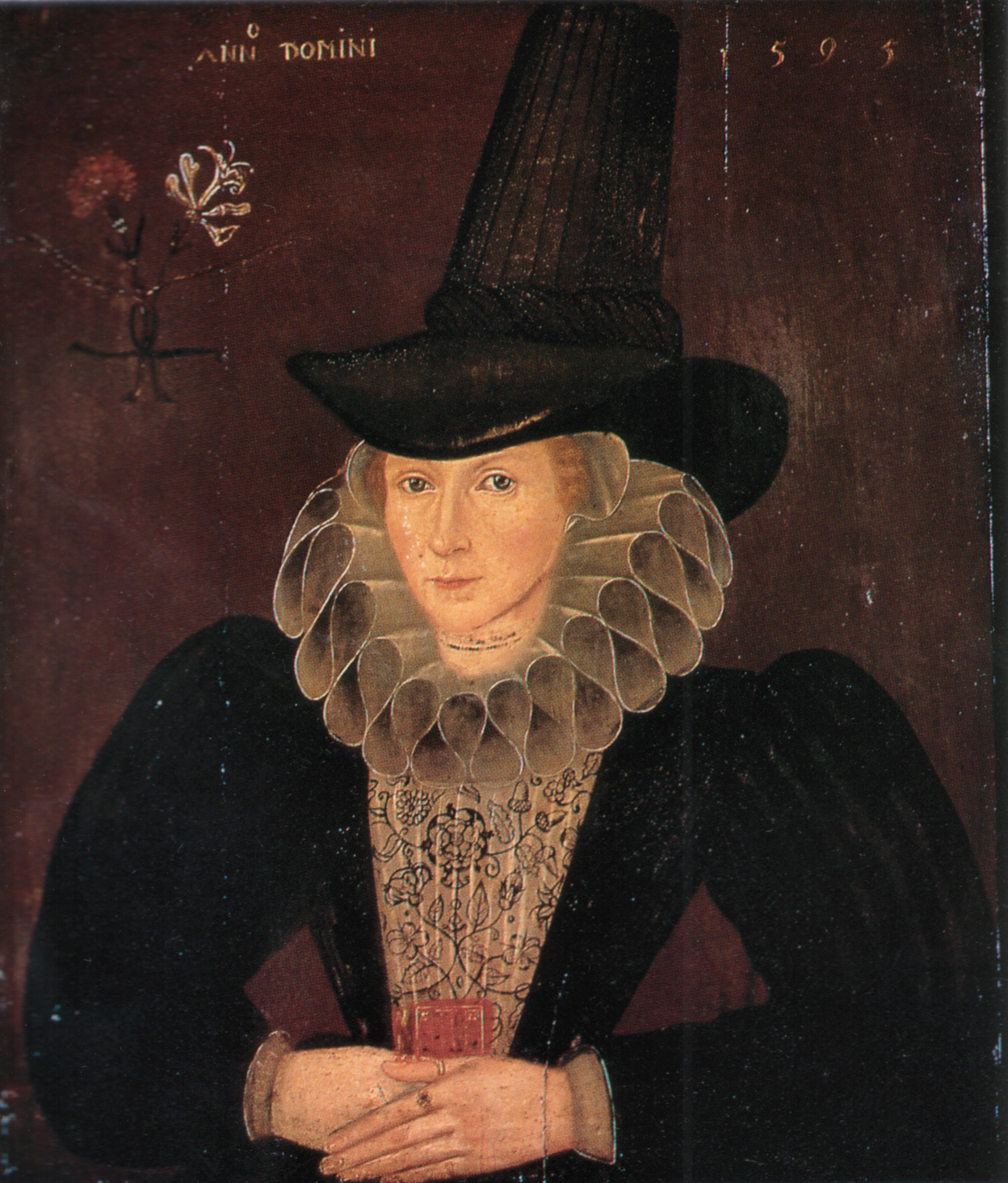
Ester Inglis, Unknown
Ester was born in England in 1571 to French Huguenot parents. She was the daughter of Nicholas Langlois and his wife, Marie Presot, who migrated to London in about 1569 and to Scotland by 1574. Marie taught Ester calligraphy as a young child.  In about 1596 Ester married Scotsman Bartholomew Kello, a minister and sometimes clerk for Queen Elizabeth. Bartholomew was apparently well educated and would write Latin verses that praised his wife.

Artwork

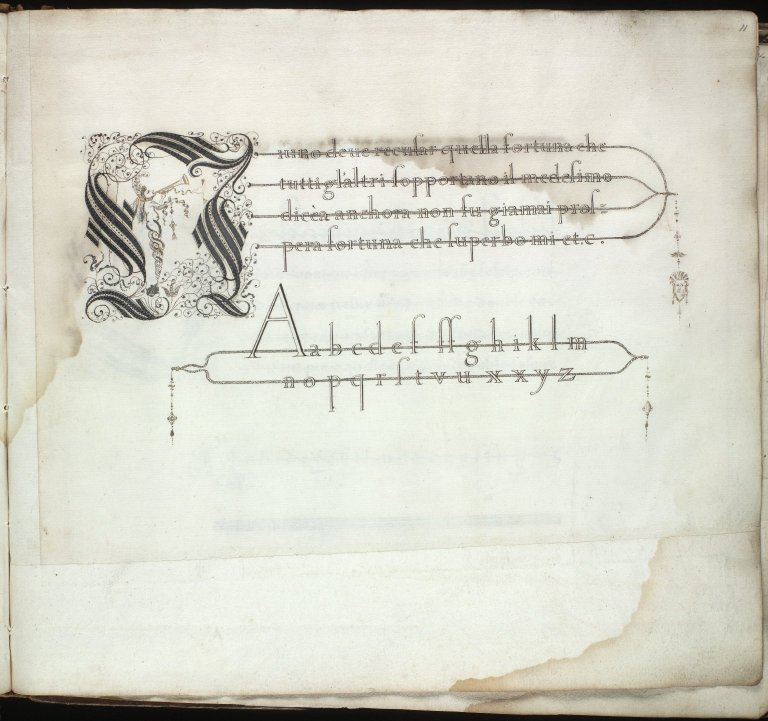
Ester was a highly skilled calligrapher, some writers have described it as extra-ordinary. She mastered the usual styles of the time along with most of the ornamental styles, including lettera mancina (mirror writing), lettere piacevolle (with curling terminals to ascenders and descenders), lettre pattee with triangular serifs, the trembling line known as lettera rognosa, and lettera tagliata where each line is broken horizontally to give a continuous white line through the letters.

    Image from object titled 'Specimens of Calligraphy; Specimens of Calligraphy'    

Margaret Macaulay writes the following regarding Esters work: "(she) could work to the minutest scale, fitting eight lines into a vertical measurement of only 18mm, and averaging 23 words to a four-inch line. Metal pens were at an experimental stage, so that goose pens, with crow quills for finer work, were mainly used. The description of Esther as ‘Mistresse of the Golden Pen’ is complimentary only. Gold pens were awarded as prizes for major writing competitions."

Esters skill didn't end with the written word. She illuminated the pages, sometimes adding tiny self-portraits. She also embroidered the covers for her books. The books were small -- ranging from about 5.5 inches X 6.5 inches to the smallest at 1.25 x 1.75 inches. She was prolific - there are currently 50 of her books surviving.

Career

There are few records of Ester receiving any payment for these works. What is apparent is that they were used as gifts to curry favor with the Court. It also appears that, from time to time they were created and presented with the hope of receiving a payment. Many of her little books are dedicated to members of the Protestant circles in England and Europe, including Elizabeth I; James VI and I; Prince Henry; Prince Charles; Lucy Harington, Countess of Bedford; Robert Cecil, Earl of Salisbury; Sir Anthony Bacon; Prince Maurice of Nassau; Catherine de Parthenay, Duchess of Rohan; and Catherine de Bourbon, sister of Henri IV. It must have been difficult for Ester to spend that much time and effort on a book then turn it over with no assurance of receiving any compensation.

Ester also used her calligraphic skills to assist her husband in his position as Clerk of Passports. She made copies of documents and wrote foreign correspondence. This is where it gets interesting. Some of her small books appear to have supported his involvement with the secret negotiations for the succession of James VI to the English throne.  Some scholars of the era go so far as to suggest that Bartholomew used these little gift books as pretext to travel abroad as a spy.

Hummm...exquisite calligrapher, amazing miniaturist, incredible embroiderist, and political reformer...pretty badass, I think!

+++++++++++++++++++++++

Selected Sources

Campbell, Julie D. and Anne R. Larsen, Editors. Early Modern Women and Transnational Communities of Letters
Carney, Jo Eldridge. Renaissance and Reformation, 1500-1620: A Biographical DictionaryMacaulay, Margaret. Mistresse of the Golden Pen.  http://textualities.net/margaret-macaulay/mistresse-of-the-golden-pen


Wednesday, November 27, 2019

Supporting Player.....

Can you imagine being incredibly talented, but almost all of your work being 'lost' because you are so good at what you do? It appears that is exactly what happened to Marietta Robusti, a Venetian painter of the late 16th Century.

Image result for marietta robusti"
Self-Portrait, Marietta Robusti
Marietta Robusit (1554-1590) was the eldest child of the gifted Venetian painter Jacopo Robusti better known as ‘Tintoretto'. She is said to have been a child prodigy, learning how to paint from a very young age and to have worn boys clothes until she was 15 so that she could more easily accompany her father. She and two of her siblings apprenticed in her fathers workshop and Marietta was especially adept at creating the same flamboyant images that her father was so well known for.

By the time she was 14 Marietta had captured the attention of Holy Roman Emperor Maximillian II and King Philip II of Spain. Both rulers tried to entice Marietta to come to their courts. Her father talked her out of these offers, some say because he was so fond of her, others because he relied heavily on her help in the workshop. Either way, Marietta stayed in Venice and Tintoretto arranged for her to marry a jeweler, Mario Augusti. In the marriage contract Augusti agreed that after the wedding he and Marietta would live in the house with Tintoretto until the day Tintoretto died. Smooth dad...real smooth.

Image may contain: 1 person
Allegory of Wisdom, Marietta Robusti
The bread and butter work for painters were commissioned portraits, and Marietta was very good at portraits. It was en vogue to have one’s portrait painted by her. Tintoretto biographer Carlo Ridolfi-Filippi wrote that Marietta had painted the portrait of all of the members of her husband's guild. While portrait work paid the bills, Marietta was also able to participated in larger commissions, such as an altarpieces.

Marietta worked alongside her father all her life. And, that is a problem for this artist. She learned  her fathers style so well that she never developed a distinct style of her own. Her career lasted 15 years or so, but very few works survive that can be directly attributed to Marietta. In a time when artists didn't consistently sign their works it is easy to understand why most of her works were attributed to her father. Some have gone so far as to suggest that, upon Tintoretto's death, his agents assigned everything in the workshop to him in order to drive the value of the works higher.

Marietta's story is illustrative of the struggles of women during this period. Women were often expected to be supporting players, sustaining the work of the father, or husband, rather than establishing their own separate career. Fortunately for us, enough of Marietta's talent shown through that now, nearly 500 years later, we can enjoy her talent and celebrate her excellent work.

++++++++++++++++++++
Selected Sources

Deye, Carola. The History of Painting Revisited - Marietta Robusti. https://thehistoryofpaintingrevisited.weebly.com/marietta-robusti.html

Fortune, Jane. The Florentine - Marietta Robusti. https://www.theflorentine.net/art-culture/2009/09/marietta-robusti/

Thursday, November 21, 2019

That's Doctor Bad-Ass to You

We are aware of countless stories about women who take care of the home and family while their husbands pursue successful careers. Sometimes these women even manage a portion or all of the 'back office' activities so that the husband can concentrate on the product or growing the business. It's been interesting to learn that in the 16th century we have several examples of men that helped run the household and manage the business side of the studio so that their talented wives could be free to paint. A recent post discussed Diana Scultori and how she and her husband worked together and ran a successful business. We also have learned that Sofonisba Angussola's husband supported her career for many years.

This trend continues with our next artist - Renaissance painter Lavinia Fontana. Lavinia was a portrait artist. Not unusual, because by this time portraits were typical for women painters.  However, Lavinia also received commissions for religious and mythological works, which sometimes included female nudes. 
Related image
Self Portrait, Lavinia Fontana

Lavinia was born in 1552 in Bologna. She was trained by her father Prospero Fontana and was active in Bologna and Rome. She is regarded one of the few, and maybe the first female career artist in Western Europe.  She relied on commissions for her income; an income which was used to support her family. Her husband -  Gian Paolo Zappi - was a fellow artist and student of her father. As Lavinia's success grew Gian assisted with her work,  served as her agent and raised their eleven children.  

Yes, eleven children. That didn't slow Lavinia down a bit. In addition to everything else, she got her doctorate from the University of Bologna, and she also became a member of the Academy of Rome. 

Both financially and critically successful, Lavinia's paintings were characterized by their poised compositions, attention to detail and the use of a delicate palette.  In her self portrait (above) you can see the careful attention the the placement of the figure, the detail of the clothing and the choice of color. Here she is impeccably dressed in lace and jewels. She paints herself as a scholar, studying items from an archaeological find. 


Image result for portrait of the gozzadini family
Portrait of the Gozzadini Family,
 Lavinia Fontana
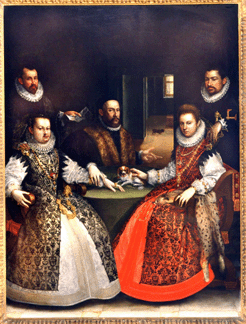
Lavinia was skilled not only at painting realistic images but also capturing the subject(s) mood. Her "Portrait of the Gozzadini Family" (left), is a psychologically complex image. it is said that this painting was commissioned by the father of the two women in the painting as a reminder that that the money they brought with them into their marriages is ultimately of their own inheritance, and not to be withheld from them by their husbands. 


Antonietta Gonzalez, Lavinia Fontana
Another unusual work is the somewhat unsettling painting of Antonietta Gonzalez. Little Antonietta  (as well as her father, two sisters and other family members) had hypertrichosis (also commonly called "werewolf syndrome"). This is a rare genetic disorder which causes an abnormal amount of hair on the body. While this could have resulted in the family being outcast, in fact they were welcomed in to the courts of Europe. Lavinia painted Antonietta in 1595 and you can almost feel the compassion for the child flowing from the paint brush. Her eyes are inquisitive and her faint smile sweet and trusting.

Lavinia had the largest body of work for a female artist up to this time - 135 paintings have been attributed to her. Her Patrons were Pope Gregory XIII, Pope Clement VII, Pope Paul V. She was the recipient of a rare honor in 1603 when Pope Clement IX summoned her to an audience in the papal palace. Clement commissioned an altarpiece for the church of San Paolo Fuori le Mura. The resulting was a 20 - foot altarpiece titled "The Stoning of St. Stephen Martyr"  and became the best known of her work. Unfortunately, the church burned in 1823 and the painting was lost.

Lavinia Fontana was a wildly talented artist. She was a creative, intellectual woman who was an inspiration for artists such as Artemisia Gentileschi and Elisabetta Sirani (who we will learn more about in the upcoming weeks). But most importantly, she was a bad-ass that portrayed herself as a painter, a musician and a scholar.


++++++++++++++++++++++++

Selected Sources

Great Women Artists. Phaidon Editors


Lavinia Fontana Facts. https://biography.yourdictionary.com/lavinia-fontana

McIver, Katherine A. “Lavinia Fontana's ‘Self-Portrait Making Music.’” Woman's Art Journal, vol. 19, no. 1, 1998, pp. 3–8. JSTOR, www.jstor.org/stable/1358647.