Wednesday, November 27, 2019

Supporting Player.....

Can you imagine being incredibly talented, but almost all of your work being 'lost' because you are so good at what you do? It appears that is exactly what happened to Marietta Robusti, a Venetian painter of the late 16th Century.

Image result for marietta robusti"
Self-Portrait, Marietta Robusti
Marietta Robusit (1554-1590) was the eldest child of the gifted Venetian painter Jacopo Robusti better known as ‘Tintoretto'. She is said to have been a child prodigy, learning how to paint from a very young age and to have worn boys clothes until she was 15 so that she could more easily accompany her father. She and two of her siblings apprenticed in her fathers workshop and Marietta was especially adept at creating the same flamboyant images that her father was so well known for.

By the time she was 14 Marietta had captured the attention of Holy Roman Emperor Maximillian II and King Philip II of Spain. Both rulers tried to entice Marietta to come to their courts. Her father talked her out of these offers, some say because he was so fond of her, others because he relied heavily on her help in the workshop. Either way, Marietta stayed in Venice and Tintoretto arranged for her to marry a jeweler, Mario Augusti. In the marriage contract Augusti agreed that after the wedding he and Marietta would live in the house with Tintoretto until the day Tintoretto died. Smooth dad...real smooth.

Image may contain: 1 person
Allegory of Wisdom, Marietta Robusti
The bread and butter work for painters were commissioned portraits, and Marietta was very good at portraits. It was en vogue to have one’s portrait painted by her. Tintoretto biographer Carlo Ridolfi-Filippi wrote that Marietta had painted the portrait of all of the members of her husband's guild. While portrait work paid the bills, Marietta was also able to participated in larger commissions, such as an altarpieces.

Marietta worked alongside her father all her life. And, that is a problem for this artist. She learned  her fathers style so well that she never developed a distinct style of her own. Her career lasted 15 years or so, but very few works survive that can be directly attributed to Marietta. In a time when artists didn't consistently sign their works it is easy to understand why most of her works were attributed to her father. Some have gone so far as to suggest that, upon Tintoretto's death, his agents assigned everything in the workshop to him in order to drive the value of the works higher.

Marietta's story is illustrative of the struggles of women during this period. Women were often expected to be supporting players, sustaining the work of the father, or husband, rather than establishing their own separate career. Fortunately for us, enough of Marietta's talent shown through that now, nearly 500 years later, we can enjoy her talent and celebrate her excellent work.

++++++++++++++++++++
Selected Sources

Deye, Carola. The History of Painting Revisited - Marietta Robusti. https://thehistoryofpaintingrevisited.weebly.com/marietta-robusti.html

Fortune, Jane. The Florentine - Marietta Robusti. https://www.theflorentine.net/art-culture/2009/09/marietta-robusti/

Thursday, November 21, 2019

That's Doctor Bad-Ass to You

We are aware of countless stories about women who take care of the home and family while their husbands pursue successful careers. Sometimes these women even manage a portion or all of the 'back office' activities so that the husband can concentrate on the product or growing the business. It's been interesting to learn that in the 16th century we have several examples of men that helped run the household and manage the business side of the studio so that their talented wives could be free to paint. A recent post discussed Diana Scultori and how she and her husband worked together and ran a successful business. We also have learned that Sofonisba Angussola's husband supported her career for many years.

This trend continues with our next artist - Renaissance painter Lavinia Fontana. Lavinia was a portrait artist. Not unusual, because by this time portraits were typical for women painters.  However, Lavinia also received commissions for religious and mythological works, which sometimes included female nudes. 
Related image
Self Portrait, Lavinia Fontana

Lavinia was born in 1552 in Bologna. She was trained by her father Prospero Fontana and was active in Bologna and Rome. She is regarded one of the few, and maybe the first female career artist in Western Europe.  She relied on commissions for her income; an income which was used to support her family. Her husband -  Gian Paolo Zappi - was a fellow artist and student of her father. As Lavinia's success grew Gian assisted with her work,  served as her agent and raised their eleven children.  

Yes, eleven children. That didn't slow Lavinia down a bit. In addition to everything else, she got her doctorate from the University of Bologna, and she also became a member of the Academy of Rome. 

Both financially and critically successful, Lavinia's paintings were characterized by their poised compositions, attention to detail and the use of a delicate palette.  In her self portrait (above) you can see the careful attention the the placement of the figure, the detail of the clothing and the choice of color. Here she is impeccably dressed in lace and jewels. She paints herself as a scholar, studying items from an archaeological find. 


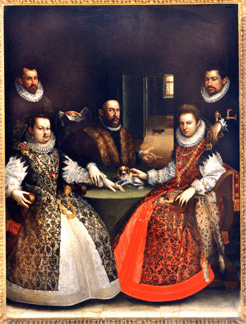
Image result for portrait of the gozzadini family
Portrait of the Gozzadini Family,
 Lavinia Fontana
Lavinia was skilled not only at painting realistic images but also capturing the subject(s) mood. Her "Portrait of the Gozzadini Family" (left), is a psychologically complex image. it is said that this painting was commissioned by the father of the two women in the painting as a reminder that that the money they brought with them into their marriages is ultimately of their own inheritance, and not to be withheld from them by their husbands. 


Antonietta Gonzalez, Lavinia Fontana
Another unusual work is the somewhat unsettling painting of Antonietta Gonzalez. Little Antonietta  (as well as her father, two sisters and other family members) had hypertrichosis (also commonly called "werewolf syndrome"). This is a rare genetic disorder which causes an abnormal amount of hair on the body. While this could have resulted in the family being outcast, in fact they were welcomed in to the courts of Europe. Lavinia painted Antonietta in 1595 and you can almost feel the compassion for the child flowing from the paint brush. Her eyes are inquisitive and her faint smile sweet and trusting.

Lavinia had the largest body of work for a female artist up to this time - 135 paintings have been attributed to her. Her Patrons were Pope Gregory XIII, Pope Clement VII, Pope Paul V. She was the recipient of a rare honor in 1603 when Pope Clement IX summoned her to an audience in the papal palace. Clement commissioned an altarpiece for the church of San Paolo Fuori le Mura. The resulting was a 20 - foot altarpiece titled "The Stoning of St. Stephen Martyr"  and became the best known of her work. Unfortunately, the church burned in 1823 and the painting was lost.

Lavinia Fontana was a wildly talented artist. She was a creative, intellectual woman who was an inspiration for artists such as Artemisia Gentileschi and Elisabetta Sirani (who we will learn more about in the upcoming weeks). But most importantly, she was a bad-ass that portrayed herself as a painter, a musician and a scholar.


++++++++++++++++++++++++

Selected Sources

Great Women Artists. Phaidon Editors


Lavinia Fontana Facts. https://biography.yourdictionary.com/lavinia-fontana

McIver, Katherine A. “Lavinia Fontana's ‘Self-Portrait Making Music.’” Woman's Art Journal, vol. 19, no. 1, 1998, pp. 3–8. JSTOR, www.jstor.org/stable/1358647.


Wednesday, November 13, 2019

Musical Expressions of Intellect and artistry

I'm taking a bit of a detour with today's post. As you know, dear reader, the past few months have been focused on visual artists. During that research I've come across some interesting Bad-Ass women who express themselves with music. I thought I'd share their stories.

Clara Tott (1440 - 1520) worked at the Court in Munich as a singer. Her father was Gerhard Tott, a city Councilman. Much of Clara's story seems to center around her love affair and eventual marriage to Frederick I, Elector Palatine. The pair tried to keep their relationship secret, but in 1472, when their eldest son wanted a position in the cathedral chapters of Speyer and Worms, they came clean about their marriage.

Secret marriages aside, Clara was apparently influential in musical circles. Scholars say that she was musically talented and had a lasting effect on the musical life at court in Heidelberg. When Fredrick wanted to organize a local choir, Clara convinced him to appoint the famous singer Johann Steinwert von Soest as its leader.

Image result for Casulana [Mezari], MaddalenaMaddalena Casulana (c. 1544 – c. 1590) was likely born at Casole d'Elsa (based on her name). Little is known about her early life, but it is believed that she received her musical education in Florence. She was a composer, and lutenist and is the first female composer to have her music printed and published in the history of western music.

It appears that Maddalena was close to the de' Medici family. Her first book of madrigals included the following dedication to Isabella de' Medici: "[I] want to show the world, as much as I can in this profession of music, the vain error of men that they alone possess the gifts of intellect and artistry, and that such gifts are never given to women." This is a telling statement coming from Maddalena - it demonstrates how she viewed being a female composer at a time when the field was dominated by men.

Related image
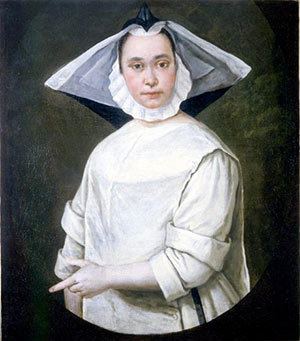
Caterina Assandra, Unknown
Caterina Assandra (1590 – 1618) was an Italian nun and composer of composer of a number of motets and organ pieces. I had to learn a bit about motets and quickly found that I am no musical scholar! During the Renaissance a motet could be secular or religious. In general this is a type of music is performed by several voices. Motets are "polyphonic", they consist of two or more simultaneous lines of independent melody. If you are musically astute, you might be thinking "what's the big deal, that's how choral music is written!". Correct, in the 21st century. In the 16th century, that style was evolving and Caterina was right there in the middle of changing musical styles.

There are approximately 14 known compositions attributed to Caterina. She was the first Italian nun to have an entire collection of musical works published.

Want to hear some of the work of Maddalena and Caterina? Hop over to YouTube and check out Caterina's Duo Seraphim and Maddalena's  Vagh' amorosi augelli.

Let me know below if you enjoyed hearing about these musical women!


Thursday, October 31, 2019

Badass Artist....and Business Woman


Diana Mantuana, better known as Diana Scultori, was an engraver and print maker from Mantua, Italy. In fact, Diana is one of the earliest known female engravers. She came from a family of engravers. Her father, Giovanni Battista Ghisi, was a painter, sculptor and engraver. Her brother Adamo Scultori was also an engraver and painter.

With so many of these artists I find my self needing to be educated on the medium in which they practiced. I learned about enameling when I was studying Suzanne de Court. Now, I've found that I need an education on engraving. In the 16th century engraving was done by first etching the design onto copper plates. Then the artist used a burin, or graver, to cut thin furrows in the plates surface. The burin was a prism shaped bar of hardened steel with a sharp point and wooden handle. This was pushed across the surface of the plate away from the artist, the palm was used to push the burin and it was guided by the thumb and forefinger. When the image was complete ink would be applied to the surface of the plate, and the excess wiped away, leaving ink in the furrows. The plate was then pressed onto paper.

Historians can't quite agree on when Diana was born; some say as early as 1532 and as late as 1547. What is known is that she met the architect, Francesco da Volterra (also known as Francesco Capriani) in 1565 when he moved to Mantua. The pair married soon thereafter and traveled to Rome by 1575.


In that same year Diana applied for and received the Papal Privilege to make and market her own work. It was rare for a woman to receive a Papal Privilege; it meant that Diana could establish a name for her household, and to sign her work. The privilege gave Diana a way to protect her engravings from being copied and then sold “by others of either sex, but most especially book dealers, sculptors, engravers and printers”. If her work was published without her consent a heavy fine was levied against the offender. One third of the fine would go to the Pope, one third to Diana, and the final third to the judge who issued the decision. This would naturally encourage a judgment in favor of the artist. In addition to such a fine, the punishment also included immediate excommunication from the Catholic Church.

Having the Papal Privilege was a good indication of Diana's business acumen. It's clear to me that Diana learned not just her craft from her father, but also how to run a business. She learned from Giovanni that courting patrons was critical to the success of the family business. She used that knowledge when she and Francesco moved to Rome. Diana's artwork promoted her husband as an architect. Diana also retained ownership of her plates which allow her to reprint and have an ongoing source for income. As the years passed the couple became successful. The husband-and-wife artists were admitted to the Congregazione dei Virtuosi del Pantheon - the Pontifical Academy of Fine Arts and Letters. To mark the occasion a pair of medallions were created bearing the likenesses of Diana and Francesco.


Diana made the acquaintance of Giorgio Vasari when she was about 19 years old and he recorded the following in his journal:

"All in all, from what I saw last time I was in Mantua to this year, 1566, when I returned, the city is so much more ornamented and more beautiful that, if I had not seen it, I would not have believed it. What is more, the number of artisans has multiplied and keeps on multiplying. Inasmuch as this, to Giovanni Battista Mantovano (engraver of prints and excellent sculptor, whose story I related in the Lives of Giulio Romano and Marcantonio Bolognese) there were born two sons who engrave copper plates divinely, and what is more marvelous, a daughter named Diana also engraves so well that it is a wonderful thing: and when I saw her, a very well-bred and charming young lady, and her works, which are most beautiful, I was stunned."

One of the most striking characteristics in Diana's work is the attention to fine detail. Unlike oil painting, or even drawing, the engraver has to rely on a series of fine lines to create features and shadows. There would be no relying on different tones and values to create the work, only fine lines. Another interesting aspect to her work is the use of nudes or partially draped figures. At a time when women were generally not allowed to work with male models, seeing these figures in Diana's engravings is quite intriguing. On further study it is reveled that Diana would base her work on that of other artists.

Diana's contributions to the art showed what printmaking could become. She used her skill to make headway into the world of book publishing and thus established herself a a woman of letters. In a time when some considered engraving simply copy work, Diana was able to help elevate engraving to an art form.


+++++++++++++++++++++++++++++++++++++

Selected Sources

Lincoln, Evelyn (1 January 1997). "Making a Good Impression: Diana Mantuana's Printmaking Career". Renaissance Quarterly.

Letwin, Hilary "Old in Substance and New in Manner": The Scultori and Ghisi Engraving Enterprise in Sixteenth-Century Mantua and Beyond.
History of Science: Engraving. (October 2019) https://www.hsm.ox.ac.uk/engraving
Steve Bartrick Antique Prints and Maps.(October 2019) https://www.antiqueprints.com/Info/engraving.php
RISD Museum. Diana Mantuana, Renaissance engraver. (October 2019) https://risdmuseum.org/manual/292_diana_mantuana_renaissance_engraver
Museum:Remix. Diana Scultori. https://museumremix.wordpress.com/2015/07/22/diana-scultori-gallery-2-rome-and-the-papal-privilege/ (October 2019) 

Friday, October 25, 2019

But Wait...There's More!!


Seems that I have more to say about Sofonisba Angussiola. I mean, she lived to the ripe old age of 92...girl did a lot of living!

Image result for how many self portraits did sofonisba anguissola paint
Self Portrait, Sofonisba Anguissola
Sofonisba fun fact #1: She painted at least 12 self portraits. She was among the first artists to paint themselves as an artist. Her first self portrait was painted when she was about 18 years old, the last at around age 75.

Sofonisba fun fact #2:  Fabrizio de Moncada was Sofonisba's first husband who she married at the age of 39 in 1571. A short 8 years later Fabrizio died. She left Spain and set sail for Italy. It was on that ship that she met and fell in love with the ship's captain, Orazio Lomellino. She and Orazio were married in 1580, against the wishes of her family.

Image result for bernardino campi painting sofonisba anguissola
Bernardino Campi Painting
Sofonisba Anguissola
, Sofonisba Anguissola
Sofonisba fun fact # 3: One of her more interesting self portraits was Bernardino Campi Painting Sofonisba Anguissola. In this painting we see Sofonisba's teacher, Campi, painting a portrait of her. Some art historians suggest that Sofonisba painted this to mock her teacher and to prove that she was the better artist. I somehow doubt that since no contemporary evidence exists that supports this view.


Image result for van dyck portrait of sofonisba anguissola
Sofonisba Anguissola,
Sir Anthony Van Dyck
Sofonisba fun fact #4: We've already learned that Sofonisba was a mentor to other women artists of the day. But late in life she met a young Flemish painter Sir Anthony Van Dyck. She advised Van Dyck on technique and in return he painted her portrait.


Image result for sofonisba anguissola boy bitten by a crayfish
Asdrubale Being Bitten by a Crab,
Sofonisba Anguissola
Sofonisba fun fact #5: It has been said that when Michelangelo saw a sketch by Sofonisba of a smiling girl he challenged her to depict the more difficult subject of a boy crying. Sofonisba was up to the challenge and produced Asdrubale Being Bitten by a Crab. A friend of Michelangelo's later sent the sketch to Cosimo de Medici, duke of Florence, from where it was widely copied and circulated.

An Illustrious Woman

Picking up where we left off last week with the Anguissola sisters we come to the training of the girls. Sofonisba and Elena were sent to learn painting from Bernardino Campi around 1546. Elena was the second daughter and very close in age to Sofonisba. It appears that the two children were sent to live at the Campi residence and were treated like guests. As well born girls, it would have been inappropriate to have them working in the artists workshop along with male apprentices. When Campi moved to another city Sofonisba became a student of Gatti (around 1550). Scholars seem to disagree on Elena's studies at that point, however, most agree that by 1551 Elena had entered convent of San Vincenzo in Mantua as a Dominican nun, taking the name of Sister Minerva (not to be confused with her little sister Minerva).

Sofonisba became teacher to her younger sisters, Lucia, Minerva, Europa, and Anna Maria. Of these Lucia showed the most promise. According to seventeenth-century biographer Filippo Baldinucci, Lucia had the potential to "become a better artist than even Sofonisba" had she not died so young. All of the sisters continued to paint throughout their lives, but Sofonisba was definitely the most successful.

By 1554 Sofonisba traveled to Rome and it is there that she came into her own. She continued to work on her art and by 1556 she had made the acquaintance of Michelangelo (yes, that Michelangelo). The nature of their relationship is not clear; some Some scholars have suggested that she may have studied with Michelangelo for a time. Two surviving letters from Sofonisba's father Amilcare to Michelangelo demonstrate the relationship with the great artist as well as Amilcare's concern for his daughters career. In May of 1557 Amilicare sent the following message to Michelangelo,

honourable and thoughtful affection that you have shown to Sofonisba, my daughter, to whom you introduced to practice the most honourable art of painting.

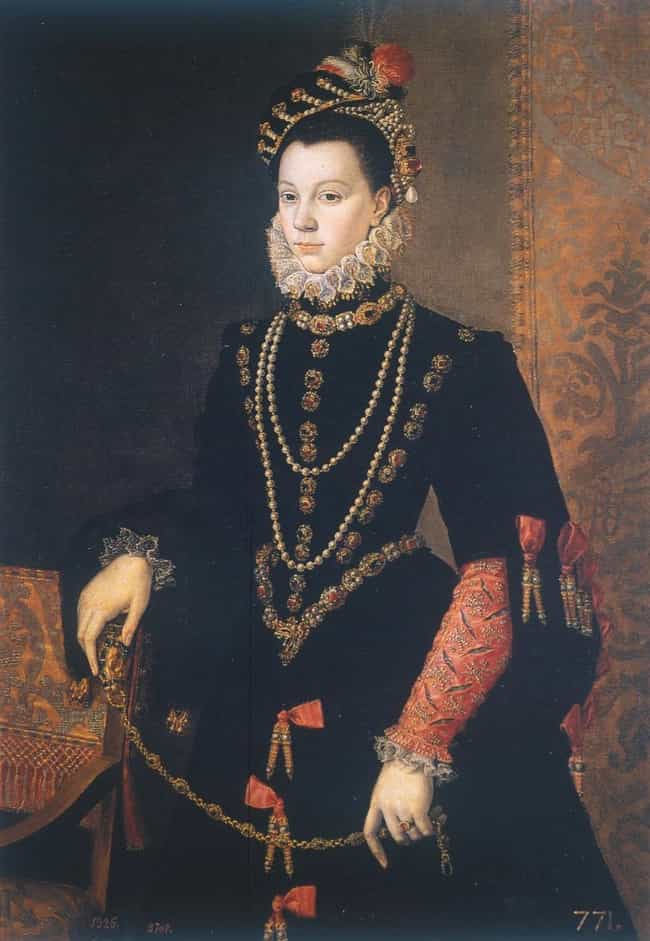
Elizabeth of Valois is listed (or ranked) 1 on the list Famous Sofonisba Anguissola Paintings
Elisabeth of Valois, Sofonisba Anguissola
Amilcare wrote again in 1558 thanking Michelangelo again for his praise of Sofonisba's paintings. This letter also underscores the friendship between Michelangelo and Amilcare.
Michelangelo's apparent fondness for the family seems to have helped Sofonisba's career.  Contemporary accounts show that Sofonisba's drawings were circulated among the artistic community and at least one drawing was sent to Duke Cosimo I.

Certainly the renown that Sofonisba gained in Italy helped to secure her position as lady-in-waiting at the Spanish court. In 1559 Sofonisba traveled to Madrid where she took up residency as court painter and painting tutor to Elisabeth of Valois, Phillip II's queen. Sofonisba spent several years at the Spanish court and was held in high regard. There she produced several official portraits of the members of the Royal Family and other members of the court.

These portraits were more difficult than her earlier somewhat playful paintings of her family members. An official portrait had to be precise and detailed. Sofonisba would have had to spend hours painting the fine lace collars, and intricate fabrics all while perfecting the face of the sitter.
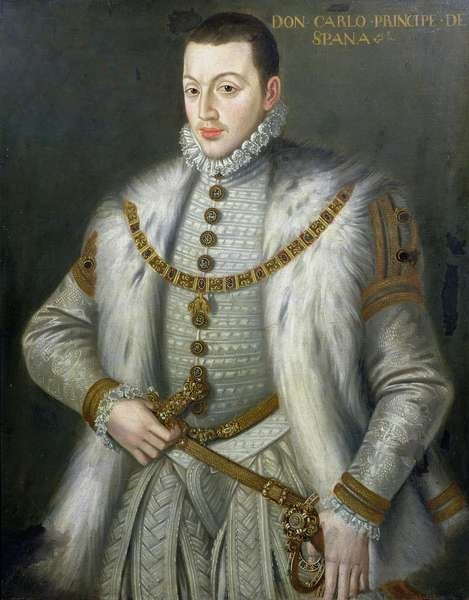
Sofonisba Anguissola. Portrait of Don Carlos, son of Philip II of Spain
 Don Carlos, son of Philip II of Spain, Sofonisba Anguissola
Sofonisba spent about 10 years at the Spanish court. Elisabeth of Valois died in 1568. Some scholars say that Sofonisba was very sad at her passing and asked King Phillip if she could be released from service. Phillp was apparently fond of Sofonisba and wanted to make sure her future was secure so he arranged a marriage (and paid her dowry) with Sicilian, Fabrizio de Moncada. Along with the dowry a royal pension was settled on Sofonisba.

Sofonisba continued to paint and teach the rest of her life. She acted as patroness to several female artists of the day that we will learn more about in the coming weeks:  Lavinia Fontana, Barbara Longhi, Fede Galizia and Artemisia Gentileschi.

After Fabrizio's death, Sofonisba fell in love with a sea captain and merchant, Orazio Lomellino. Orazio was fairly wealthy by all accounts. Along with Sofonisba's income from painting and teaching, her royal pension, and Orazio's business interests they were able to live quite comfortably. The two were married until Sofonisba passed from this world at the age of about 92. Their love is memorialized by Orazio in the following....

To Sofonisba, my wife, who is recorded among the illustrious women of the world, outstanding in portraying the images of man. Orazio Lomellino, in sorrow for the loss of his great love, in 1632, dedicated this little tribute to such a great woman.

— Orazio Lomellino, Inscription on Sofonisba's tomb

Sofonisba lived life on her terms. Certainly she was a trailblazer for women artists. She is the first woman to make a life long career as a financially successful working artist, teacher, and inspiration to other artists.

+++++++++++++++++++++++++++++++

Chin, Lily, "SOFONISBA ANGUISSOLA AND HER EARLY TEACHERS" (2018). CUNY Academic Works. https://academicworks.cuny.edu/hc_sas_etds/276

Kilroy-Ewbank, Dr. Lauren. Smart History: Sofonisba Anguissola. https://smarthistory.org/sofonisba-anguissola/ (Last visited: October 2019)

Perlingieri, I. (1988). Sofonisba Anguissola's Early Sketches. Woman's Art Journal, 9(2), 10-14. doi:10.2307/1358314

Thursday, October 17, 2019

A Bad-Ass Dad and His Bad-Ass Daughters

The training of young artists during the middle ages and renaissance intrigues me. The first organized craft guilds came into being in the 12th century in Western Europe and the master/apprentice system shortly followed. An apprentice was a person that was bound by legal agreement to work for a master craftsman for a specific amount of time in return for instruction in a trade, art or business. Apprentices were treated as part of the master's family; masters were obligated to provide room and board for the apprentice.

I've not yet discovered a record of girls being apprenticed to a master painter during this period. Perhaps this is because girls were expected to keep a home, and have children when they reached adult hood. Also, apprentices shared common living quarters, so it would have been considered inappropriate to have boys and girls sharing sleeping arrangements. There is also the consideration of having a male master overseeing a young girl and the potential for unsuitable behavior.

In the last half of the 16th century things begin to change. Apprenticeships were codified and placed into statue in England in 1563. The Statute of Artificers defined how many apprentices a master could have, how long the apprenticeship would last and how disputes between master and apprentice would be settled. Records of the time suggest that girls might be eligible for apprenticeships in some trades such as buttonmakers, lacemakers, and tailors.

Sofonisba Anguissola, The Chess Game
Sixteenth century accounts reveal that  young girls pursuing painting would sometimes have teachers outside the convent or home. Often the teacher would come to the girls home to train her; occasionally the girl might visit the artists workshop.

Fortunately for  the Anguissola girls, their dad saw the value in providing a well rounded education that included training in fine art. Legend has it that Amilcare Anguissola, a nobleman from Cremona,  asked each of his six daughters what they wanted to study. Five of the six said painting and one choosing writing. Sofonisba and Lucia were the most well known of the sister artists. There was also one boy, Asdrubale, who's sole claim to fame seems to be that he was Sofinisba's brother.

Lucia Anguissola, Self Portrait, 1557.jpg
Self Portrait, Lucia Anguissola
When Sofonisba was about 14 years old Amilcare arranged for her to study with  Bernardino Campi a highly respected portrait painter from Cremona. When Campi moved to another city she studied with Bernardino Gatti. It is important to note that secondary writers refer to Sofonisba as apprenticing to these two artists, but I've not yet discovered any contemporary source material that confirms she was in an apprenticeship relationship with either artist.

There is still so much to tell about this family. In a first time ever event for Bad-Ass Women Artist Blog the story of  the Anguissola girls is...

TO BE CONTINUED!


++++++++++++++++++++++++++++++


Life in Elizabethan England: Apprentices. http://elizabethan.org/compendium/80.html (Last visited: October 2019)
Cartwright, Mark. Ancient History Encyclopedia. Medieval Guilds. https://www.ancient.eu/Medieval_Guilds/ (Last visited: October 2019)
Statute of Artificers, 1563. http://www.ditext.com/morris/1563.html (Last visited: October 2019)
Evans, Richard. Technical Education Matters: Short History of Apprenticeships.  http://technicaleducationmatters.org/2011/01/06/short-history-of-apprenticeships/ (Last visited: October 2019)